

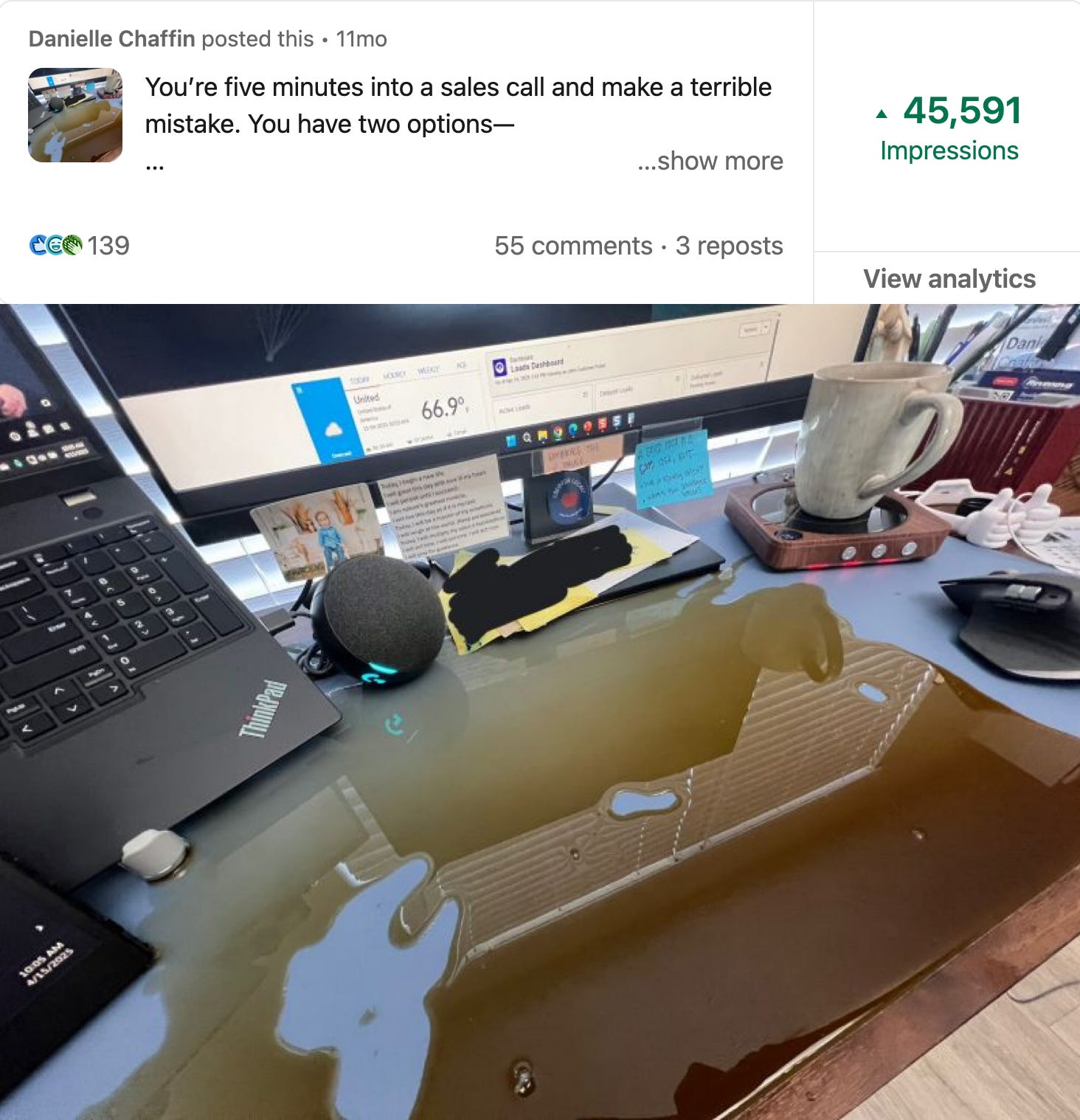
My vacuum sat in the same spot in my dining room, with the cord stretched across the floor, for three days. I tripped over the cord multiple times. My kids tripped over the cord multiple times. Yes, we could have moved it, but we didn’t. My number one viewed LinkedIn post is a photo of my desk, soaked in coffee.
My mistakes and failures are plentiful. Some are funny, others are not. Yet, all of them make me, me. And all of yours make you, you. All of us are the same. We are imperfect humans.
Imperfect humans connect with other imperfect humans. Our mistakes and failures make us relatable. It is okay, and it is good to share that with others.
Garrett Allen’s response to a LinkedIn post last week echoes my sentiments.
“There are so many cool people out there but when they get on pods or in newsletters it’s just the facade and the same lines we’ve all heard 100 times.
Everyone’s afraid to show too much or bet on the wrong thing. But that’s what’s most interesting. Being human is being wrong, betting on the wrong things, making mistakes. I want more of those stories and the understandings that come from them.”
It takes courage to be real and honest. It takes courage to talk about your struggles, your failures, your mistakes. But it makes you human, and it makes it possible to connect with other humans. People want to connect with you and learn from you. They can’t do that when everything you do or say or write appears to be effortless and without struggle or failure.
Relationships are human. Trust is human. It is difficult to trust a person who consistently sells on their fictitious perfection and bland corporate slop.
Which brings me to my next stream of thoughts.
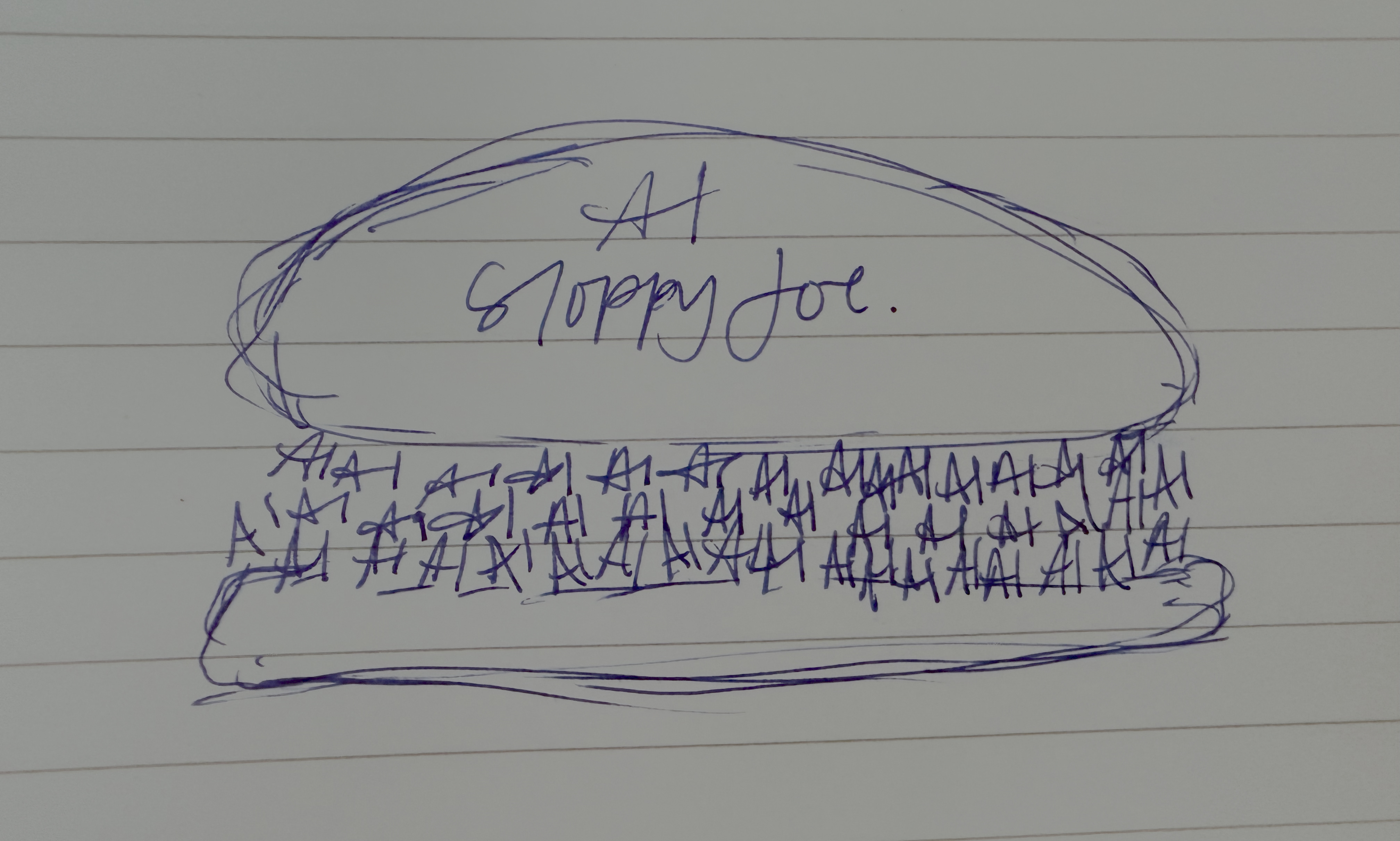
AI Sloppy Joes.
When you read my writings, I want you to hear my voice. Of course, you have to know me to know my voice, but I want to talk to you. My voice, narrating my articles, in your head.
That sounds weird when I read it out loud. I bet it wouldn’t sound as awkward if I threw it in ChatGPT. Yet, it wouldn’t sound like me. It would sound like the machine regurgitating AI sloppy joes.
AI-generated slop sounds like AI-generated slop. It’s not the em dashes or the ‘it’s this not that’ statements. It’s the flow of the writing. There are no strange angles, no lived details, no real humor, no little errors, no surprise words. It reads like it’s dead (because it is).
Maybe we can catch a fish or two with the fishing pole we’ll discuss later. Then, on Friday, we’ll have a fish fry!
You read a post or article. You mentally process it. You type an intelligent, articulate response. You read it over and think, ‘wow, that’s so good.’ Then, you click post.
Congratulations, you just spent more time and effort on your comment than the person who published the AI-generated article. Frustrating? Indeed, it is.
Writing teaches you how to think, how to learn, and how to inspire people to care about what you’re writing about. Artificial Intelligence cannot do that for you. You can do it, but no, AI cannot.
For the AI-compromised humans, you are effectively using Artificial Intelligence [a machine] to create a counterfeit version of yourself. I don’t care how much quicker you can push content out. I don’t care that your articles are seemingly intelligent. It is not you. It doesn’t sound like you. It will never be you. When you show up on a podcast or live show, it is uncomfortably obvious that your writings did not originate from you. You show up on camera. You, behind a soulless AI mask, show up in your copy/paste writings.
AI cannot replicate your unique nature. You have a soul, AI doesn’t. You have a conscience, AI doesn’t. You are passionate about what you do, AI does not care.
You were uniquely designed. You have an incredible brain. Your talents are a gift. You should steward those talents well and honor your uniqueness.
As humans, we are uniquely designed to think and create. We were designed for depth, wisdom, and love. Not just breadth, or just knowledge, or just productivity. We were made for purposes far greater than the boundaries and masks that AI attempts to place upon us.
What are the long-term implications of a society that slowly stops thinking and relies on AI for absolutely everything?
I don’t know the answer, but I can’t imagine it will be anything good. Perhaps it is a soulless society that speaks, writes, and builds only what it is fed by a large language model. Copy/paste AI sloppy joes, everywhere you look.
The moral compass that drives human behavior has no influence over a machine. AI doesn’t care about the consequences of its words or actions. AI cares about prompts, outputs, and efficiency. It doesn’t ponder a problem or idea in a quiet room, or while on a walk, or in a brainstorming session with your friends. AI doesn’t care about goodness. It [AI] could very well become one of the greatest tools of deception ever created.
Explaining freight to non-freight minds.
We’re going to take this giant ball of tangled fishing line, throw it in the air 3 times, clap 5 times, spin around, untangle it, then put it on a spinning reel and go fishing.
If I had to describe what it feels like to dissect and convey the complexities of the transportation industry to an audience who has no idea how their groceries get to the store, the fishing line analogy would be it.
We want people to listen. We want them to hear the concerns of those of us in the trucking industry. To do that, we have to talk with them, not at them. Throwing around numeric codes for the FMCSA regulations in conversation and in social media posts does very little to help the cause. Spitting out AI-generated articles does very little to help the cause.
If people don’t know what you’re talking about, they’re not going to care. If people immediately recognize AI-slop, they’re not going to read your article or posts. We want to help them care. We want to help them see the industry through our lens. We must do better in our efforts to help them.
This may be a good time to go back and re-read the previous section.
People need you, the real you.
Sounds real to me. Thank you for sharing!! 🏆