

The Supreme Court heard oral argument in Montgomery v. Caribe Transport II, LLC on March 4th of this year, and the industry has been holding its breath ever since. At the center of the case is whether the Federal Aviation Administration Authorization Act’s (“FAAAA”) preemption provision, 49 U.S.C. § 14501(c), bars state common-law negligence claims against freight brokers for negligent selection of a motor carrier or driver. A decision is expected before the Court’s summer recess, and depending on which way it lands, the freight brokerage industry as we know it may not look the same on the other side.

Most pro-broker liability commentary has focused on what brokers stand to lose and what victims have to gain. That conversation is not one I intend to dismiss. The conversation I propose, and have yet to see anyone lead with, is what happens after. What does the industry do the morning after a ruling that exposes brokers to full negligence liability for the carriers they select? And who, exactly, pays the price for that response?
Before we get too far, I want to address the strange contradiction that makes this conversation a bit uncomfortable.
The same broker who will not dispatch a carrier because of a gap in roadside inspections or a change in contact information, who has built vetting workflows sophisticated enough to flag a phone number that is no longer active, is, in the courtroom, a passive arranger who simply manages the transportation of goods on behalf of shippers from one point to another. The same ones who market their carrier intelligence as a competitive differentiator, who tell shippers their freight is safe because of the depth of their vetting technology, become, in the wake of a fatal crash, an entity with no meaningful relationship to the driver behind the wheel and no responsibility for putting him there.
That posture is not legally incoherent. It is, in certain jurisdictions and under the current federal preemption doctrine, precisely correct. This is quite the conflicting system, one in which brokers accumulate massive amounts of data, use that data to make consequential decisions about which carriers move freight and which do not, and then disclaim the significance of those decisions the moment a human life is lost. The marketing copy and the liability defense cannot both be true at the same time. Either the vetting matters or it does not.
…
The industry’s response to freight fraud and cargo theft did not require a lawsuit to be placed before the Supreme Court of the United States. The response to double brokering, identity theft schemes, chameleon carriers, email phishing attempts, stolen load board credentials, and the like has been aggressive, sweeping, and in many cases, indiscriminate. Technology platforms proliferated, and carrier onboarding requirements multiplied.
The small carrier with a clean safety record, an old phone, and a dispatcher who does everything from the corner of their home [legally and safely] learned very quickly that the industry’s fraud response was not built with them in mind. The tools designed to catch bad actors created walls that good actors could not always scale. Brokers who wanted to protect their freight and their customers quietly consolidated their carrier bases, whether intentionally or not.
Now imagine that calculus multiplied by the weight and cost of human life.
When the consequence of a poor carrier selection is not a stolen load but a wrongful death lawsuit, the rational response from a brokerage is not to vet more “carefully.” The rational response is to vet even more narrowly. There will be more technology, more rules, and more Artificial Intelligence working off those rules. Thus, the pool of carriers that brokers are willing to work with diminishes even further. This won’t be because small carriers are less safe, but because they are less defensible. A broker facing a negligence claim doesn’t want to explain to a jury why they chose a two-truck operation with a seven-year safety history over a larger carrier whose compliance department sends weekly reports or one whose FMCSA safety scores are in the green. If the unit of measurement is liability exposure, the math and processes change significantly.
When I was a broker in 2017, our vetting process was very simple. Any carrier with an MC number starting with 7 or lower and sufficient insurance — as long as they didn’t give you the intuitive red flags, we’re good to go. We do not live in that world now.
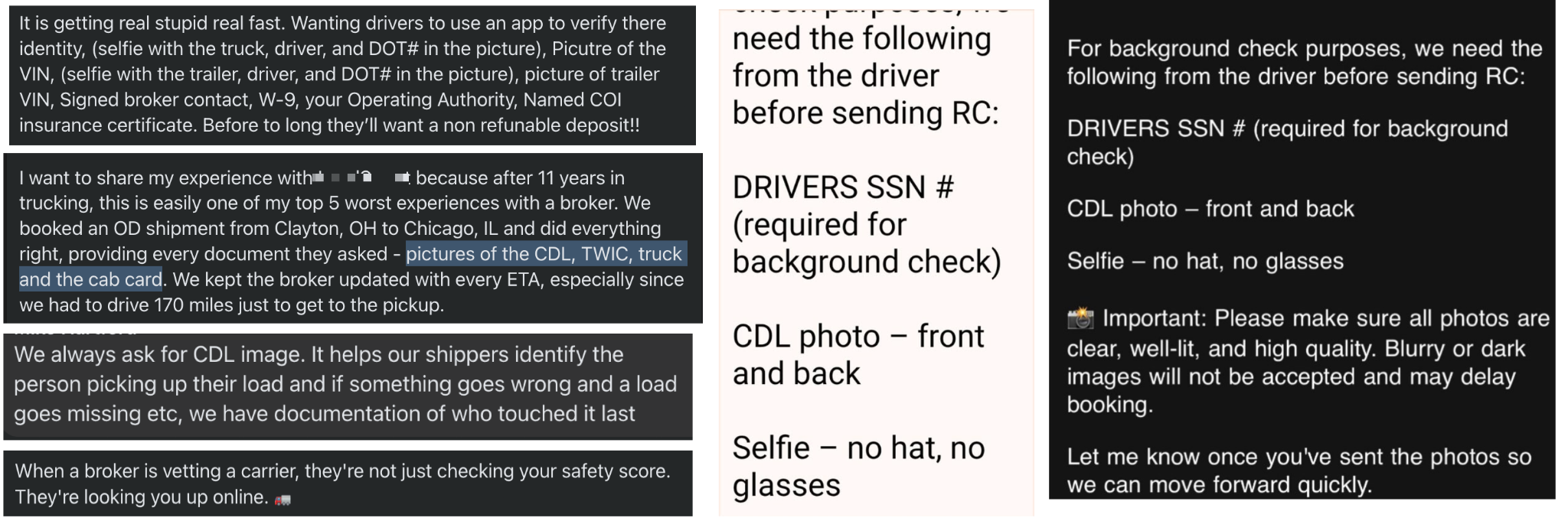
Brokers in 2026 have access to carrier safety scores, CSA data, inspection histories, out-of-service rates, insurance verification, and VIN-level connections. The more sophisticated platforms offer ELD data feeds, behavioral analytics, and monitoring that flags changes to any available data element. Brokers undoubtedly have technology that continuously monitors carriers’ compliance with existing safety regulations. Some brokerages have gone further, requesting copies of the driver’s CDL and photos of the driver with the truck to confirm identity at the time of dispatch. When a broker is doing that level of verification, they are more than a passive arranger of the transportation of the goods.
*This is not a condemnation of brokers as a whole. The people I know who do this work every day operate under great pressure. They do the job well. They truly care about the industry and the safety of our highways. Not every broker is a bad actor, just as not every carrier is.
A blanket preemption ruling, one that says federal law categorically shields brokers from state negligence claims, creates an industry in which brokers can access every piece of operational and safety data ever generated about a carrier, choose to ignore it in favor of a cheap rate, and face no consequences when that choice leads to a crash. On the other hand, a ruling that imposes unlimited, undifferentiated broker liability hits hardest the small carriers and owner/operators who are already operating on the margins of an industry that has never been particularly fair to small operators. It produces an industry in which the broker’s incentive is not to find the safest carrier but to find the most legally defensible one, and in which the criteria for defensibility are set by insurance actuaries and defense attorneys rather than actual safety outcomes.
The more honest framework here is one that distinguishes between brokers who had the data and looked away, and brokers who exercised reasonable care. It holds the brokerage accountable for sitting on shipper requirements specifying carrier criteria and booking a carrier that did not meet them. It holds the brokerage accountable for knowing that it is booking an unsafe motor carrier. It does not hold the brokerage accountable for conducting reasonable verification and booking a carrier who then did something no one could have predicted.
The question Montgomery forces us to answer is whether brokers get to operate indefinitely in a space where the data they collect obligates them to nothing. The Court’s decision this summer will not resolve that question cleanly, but the industry’s response to whatever the Court decides will absolutely tell us where accountability in this supply chain actually lives.