

Most Americans assume military logistics are locked down. I would like to think that, too, but it isn’t.
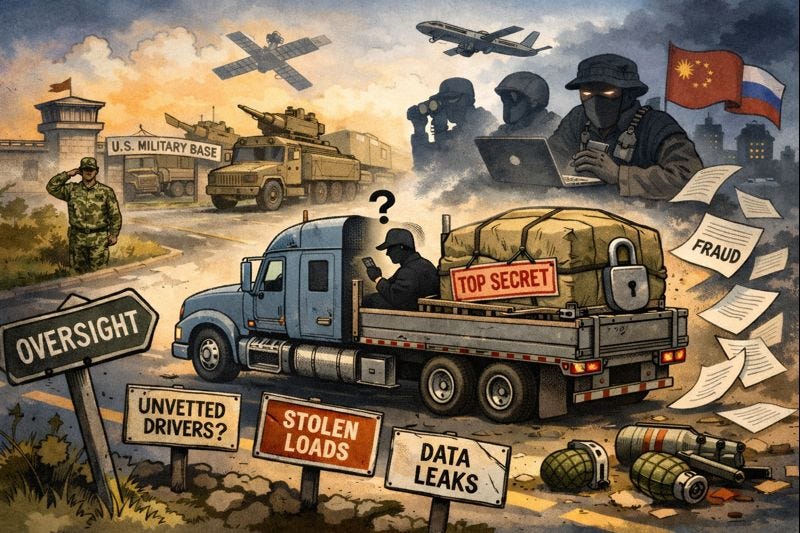
Every year, the U.S. Department of Defense/War (DoD/DoW) quietly moves hundreds of thousands of sensitive shipments across U.S. highways, including munitions, weapons components, hazardous materials, and classified equipment scheduled for destruction.
In far too many cases, the government cannot say with certainty who is driving the truck. Yes, you read that correctly, the Department of War often does not know who is behind the wheel hauling their sensitive cargo.
Before the freight ever moves, it must be planned. The systemic oversight gaps in the planning process allow unknown drivers, unverified companies, and, at times, outright fraudulent operators to transport military cargo with surprisingly little to no scrutiny. The result is a domestic logistics system vulnerable to fraud, theft, and, at worst, serious national security compromise.
Illegal U-Turn in Florida: The partial wake-up call.
On August 12, 2025, a fatal crash near Fort Pierce, Florida, shattered more than a minivan. It exposed how weak oversight in trucking can have deadly consequences.
A semi-truck driven by Harjinder Singh, a 28-year-old undocumented immigrant, made an illegal U-turn through a restricted access point on Florida’s Turnpike. The truck blocked all northbound lanes. A minivan carrying three Haitian immigrants slammed into the trailer. All three were killed instantly.
Singh had obtained commercial driver’s licenses in multiple U.S. states that issue CDLs regardless of immigration status. Despite lacking legal authorization to work at the time, there was no federal system that prevented him from operating an 80,000-pound commercial vehicle on public roads.
Yes, he was arrested. Yes, he was charged. And yes, the crash triggered federal scrutiny of how commercial driver’s licenses are issued, but none of that happened before the bodies were counted.
Regulators have no idea who’s behind the wheel of an 80,000-pound machine… until after people are dead.
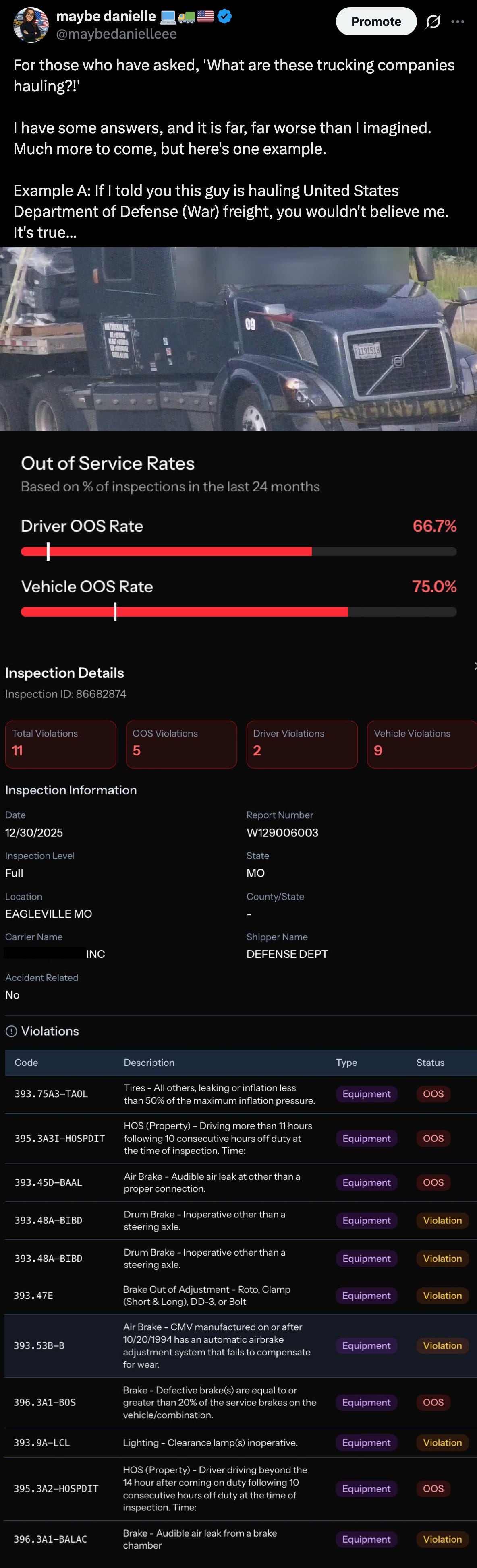
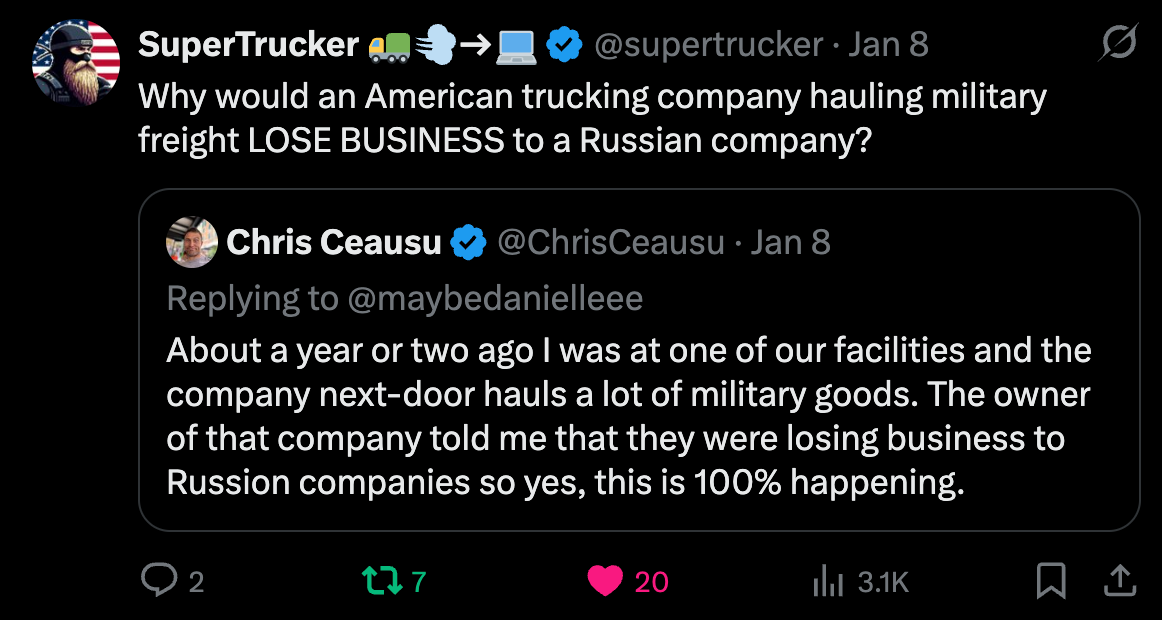
That same lack of visibility exists inside the United States military logistics. In some months, tiny trucking companies outperformed the largest contracted carriers, an operational impossibility without hidden subcontracting.
The United States Department of War has no idea who is handling their cargo.
“The DoD Doesn’t Know Who’s Behind the Wheel”
Dale Prax, a Marine Corps veteran and founder of the freight-vetting platform FreightValidate, has spent decades studying freight fraud and carrier abuse. His conclusion is blunt:
“The Department of Defense doesn’t know who’s behind the wheel.”
Prax’s work, supported by law-enforcement collaboration and real-world case data, shows that the same fraud schemes plaguing commercial freight routinely touch government shipments.
These schemes include:
Double brokering: a carrier accepts a load, then secretly hands it to someone else without notifying the other party that an extra party has now been involved.
Phantom fleets: companies with minimal or no equipment (trucks) moving impossible volumes.
Identity laundering: legitimate registration numbers used to mask unknown company representatives and drivers.
Cargo theft alone costs the freight industry $6.6 billion annually, with individual losses often exceeding $500,000. When the cargo belongs to the U.S. military, the stakes are astronomically higher.
How Military Freight Is Supposed to Work.
The DoD/DoW relies on a vast domestic transportation network overseen by U.S. Transportation Command (USTRANSCOM). Highway freight is managed primarily through the U.S. Army’s transportation arm, using a digital system called Global Freight Management (GFM).
In theory:
Only approved carriers can bid
Security requirements are defined per shipment
Drivers must be verified at pickup
Sensitive freight receives additional controls
In practice, the system isn’t designed as it should be and lacks many critical verification steps.
The System Issues.
1. Real-Time Safety or Authority Checks? None.
The military’s freight system does not automatically verify whether a carrier is active, insured, safe, or even legally authorized to operate, even though that information already exists in federal databases. This is the root of the problem.
The DoD/DoW relies on a carrier identifier, known as a SCAC (shipping code), to determine who can move military freight. But that code is not linked to the Federal Motor Carrier Safety Administration’s live registration system, which tracks whether a trucking company is actually authorized to operate. As a result, hundreds of carriers retain valid SCACs within the military’s freight system even after their federal operating authority has been revoked, expired, or never issued.
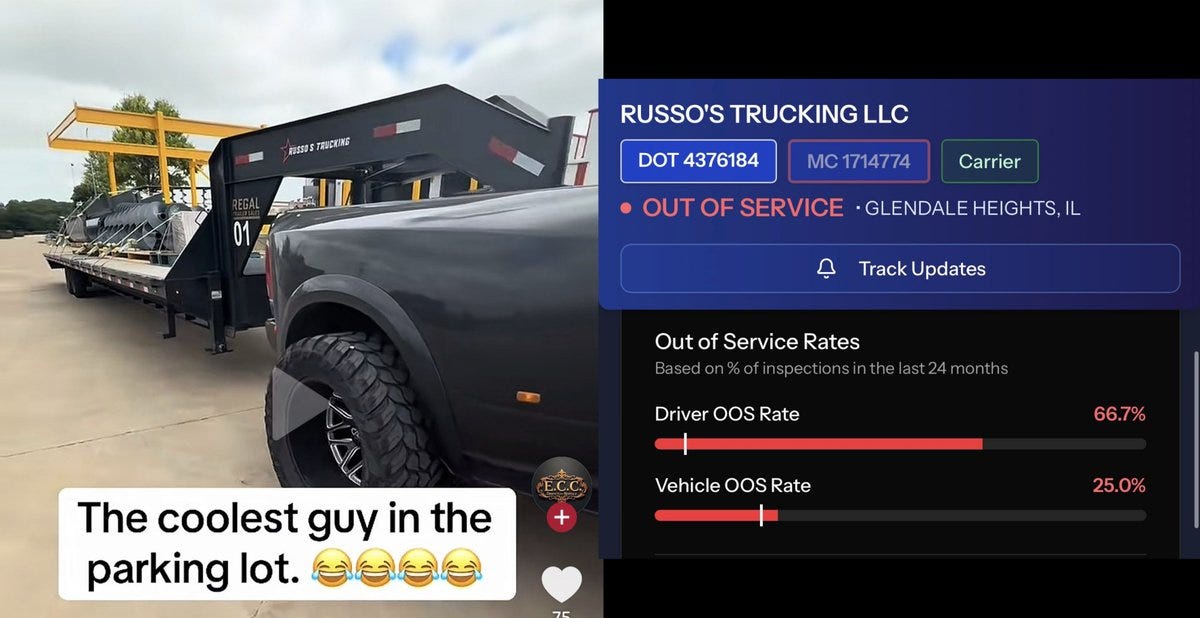
Those entities can continue bidding on and winning military shipments indefinitely. Dormant, defunct, or outright fraudulent?
No issues, here’s your award to haul military freight!
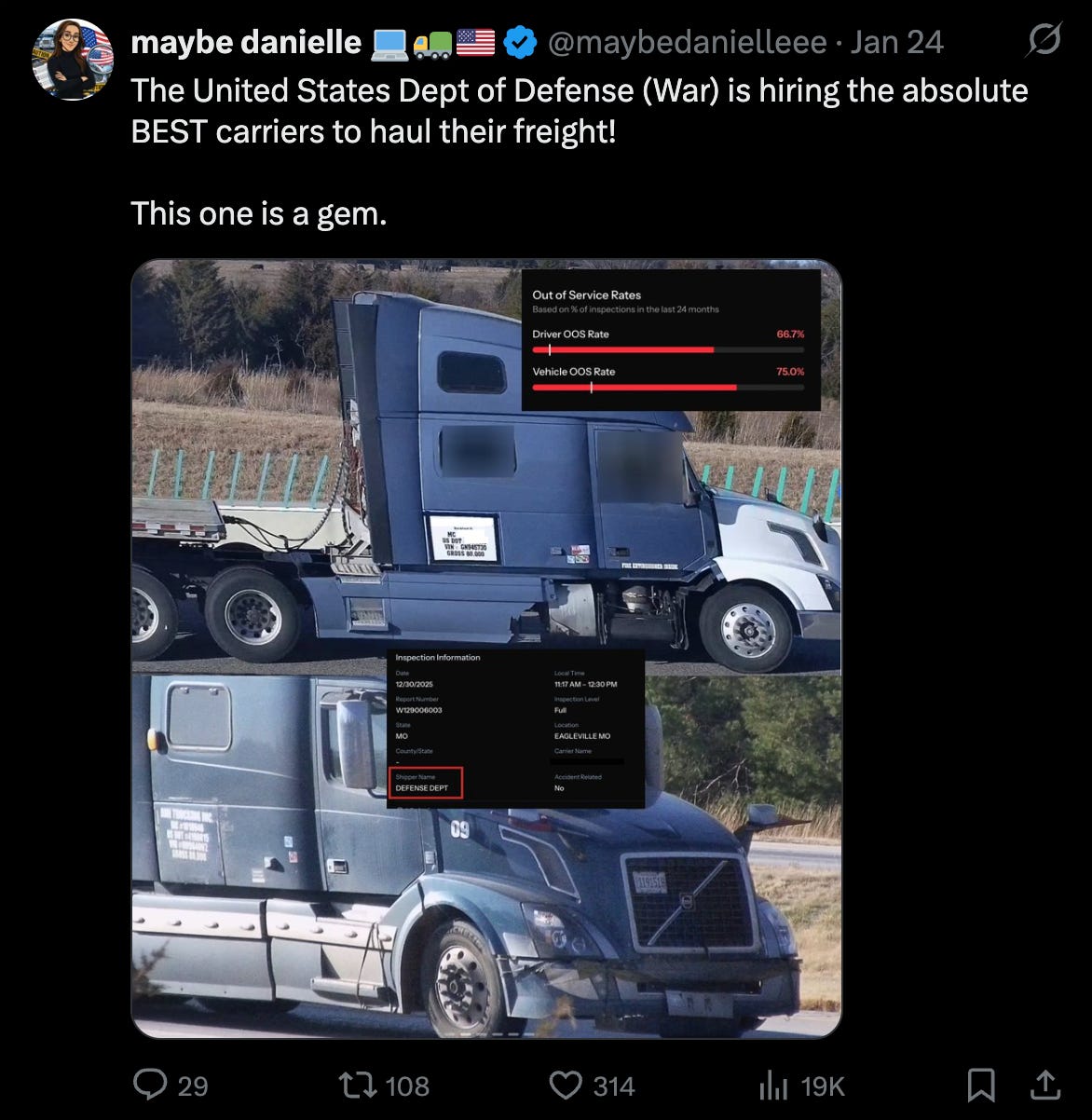
2. Zero Capacity, Zero Validation
A company with one pickup truck can be awarded dozens of sensitive shipments to be picked up on a single day. You would expect an automated safeguard, something basic, to verify whether a carrier actually has enough trucks, or the right trucks, to move the freight. No, there isn’t one.
In 2023, a carrier operating a single Ford F-150 pickup truck and a small utility trailer was awarded 32 sensitive military loads in one day through the DoD’s Global Freight Management system. Each shipment required Signature & Tally (675) service, a security designation meant to ensure controlled handling. The average trip was 127 miles. The average payment was roughly $2,000 per load, totaling more than $64,000.
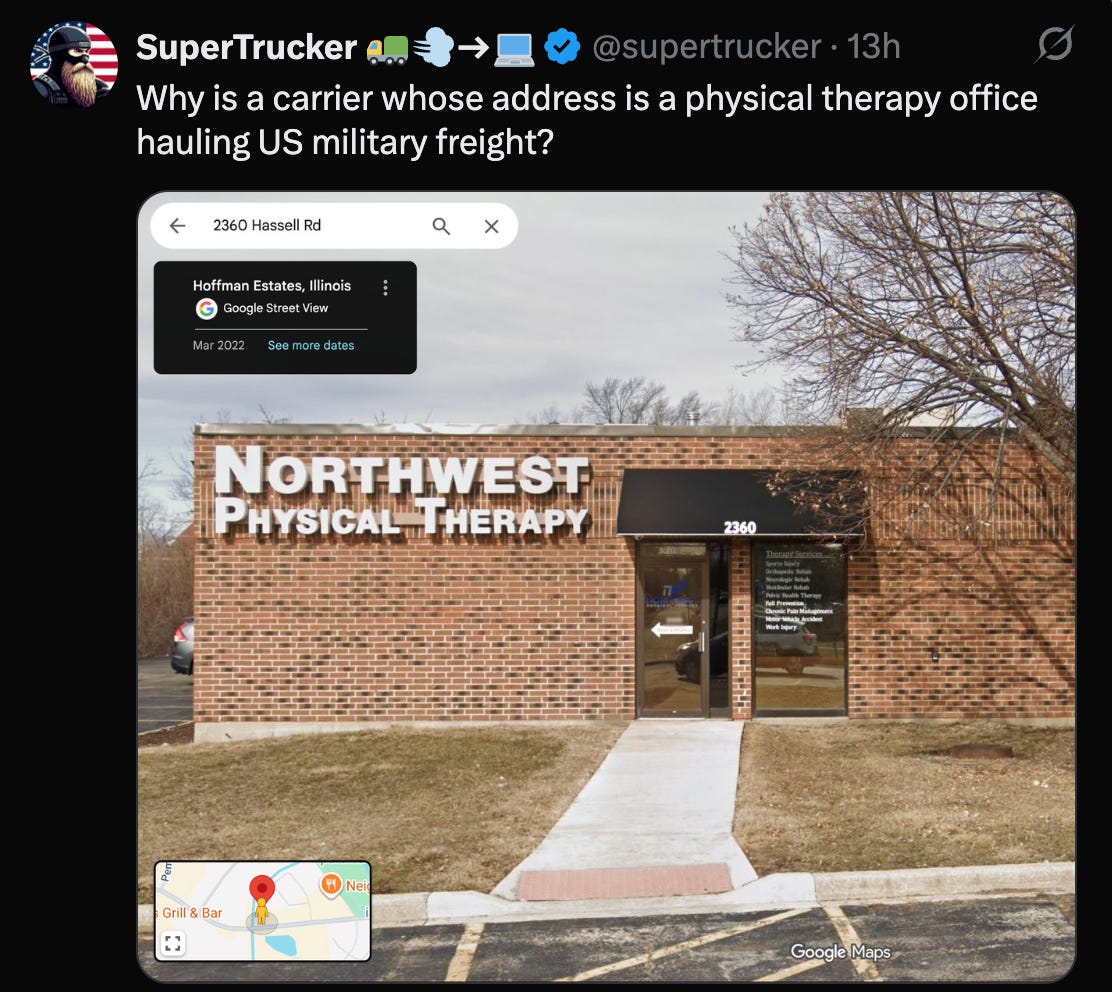
The trucking company did not have the equipment or capacity to move even one of those shipments, let alone thirty-two. Instead, the freight was quietly brokered out to unknown third parties, in violation of federal law and Department of Defense policy, exposing sensitive military cargo to drivers the government did not vet or approve.
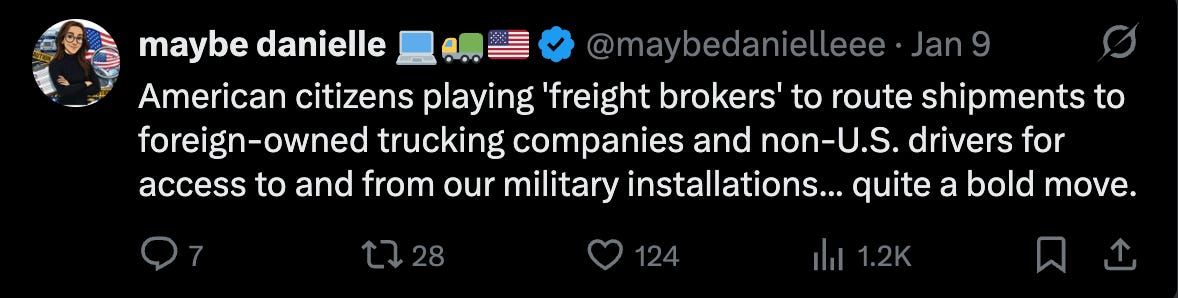
Can this carrier actually move multiple shipments on the same day? We don’t know. Here’s the freight anyway.
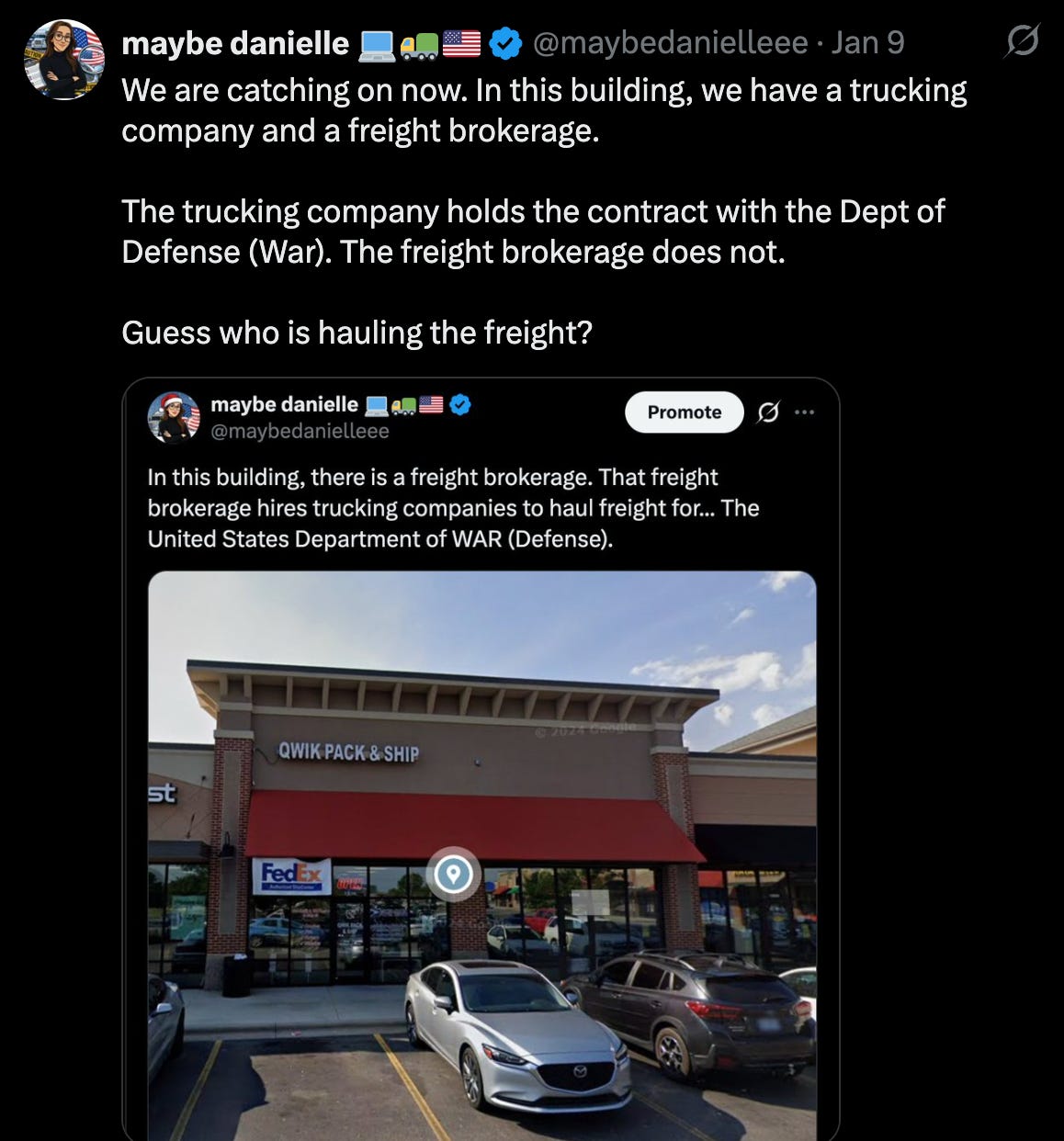
In this case, the company approved by the Department of Defense to haul freight also operates a separate freight brokerage (not approved by the DoD/DoW). The owner accepts military shipments under the trucking authority, then reassigns those loads through the brokerage, without disclosure.
Publicly available information indicates the owner resides in NIGERIA. Yet shipments awarded to his U.S.-registered trucking company were ultimately handled by unknown trucking companies and drivers, outside the military’s vetting process.
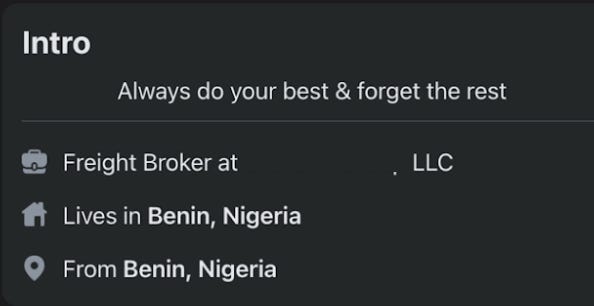
Who will be hauling the freight? We don’t know. Here’s the freight anyway.
3. Unknown & unqualified truck drivers.
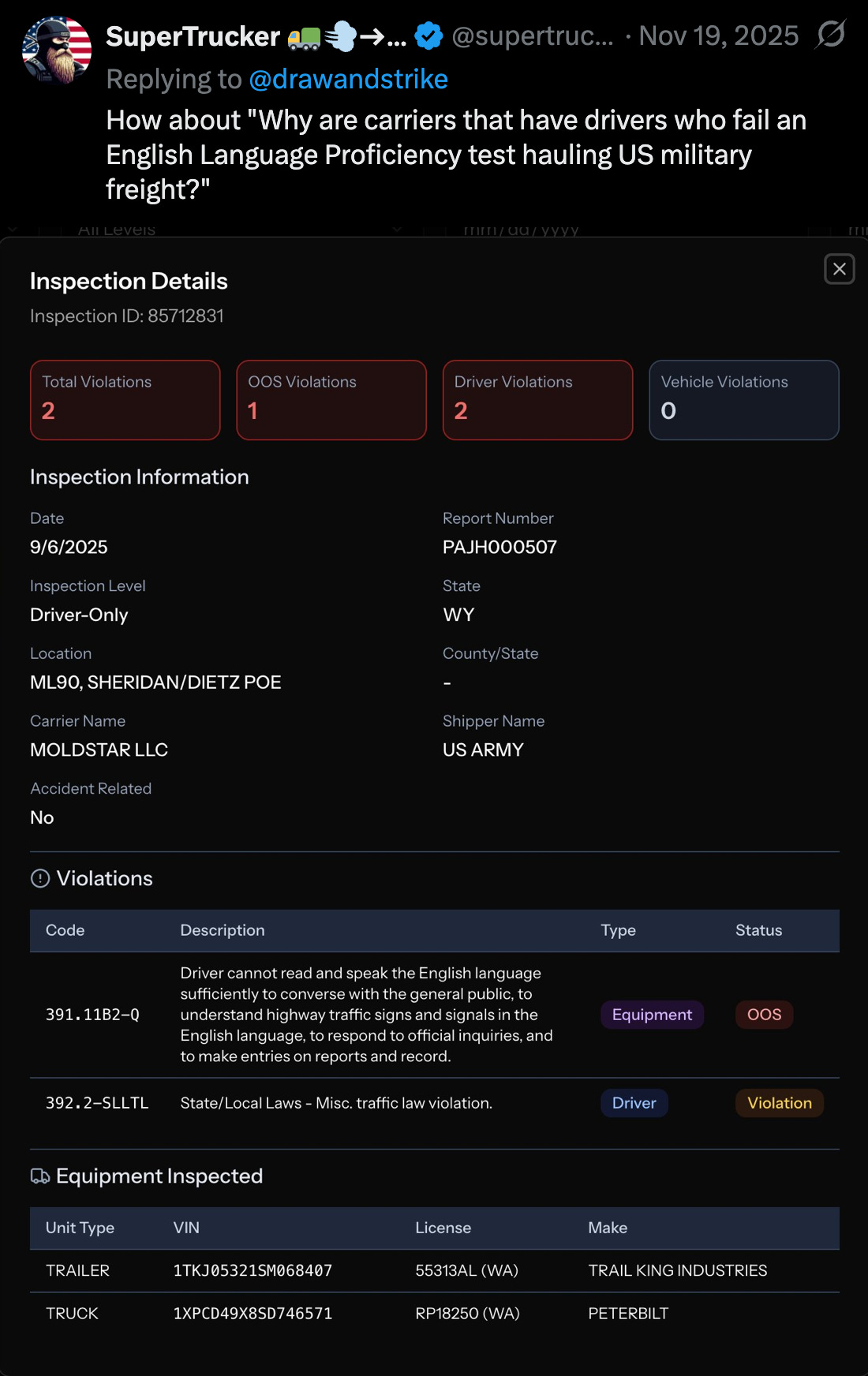
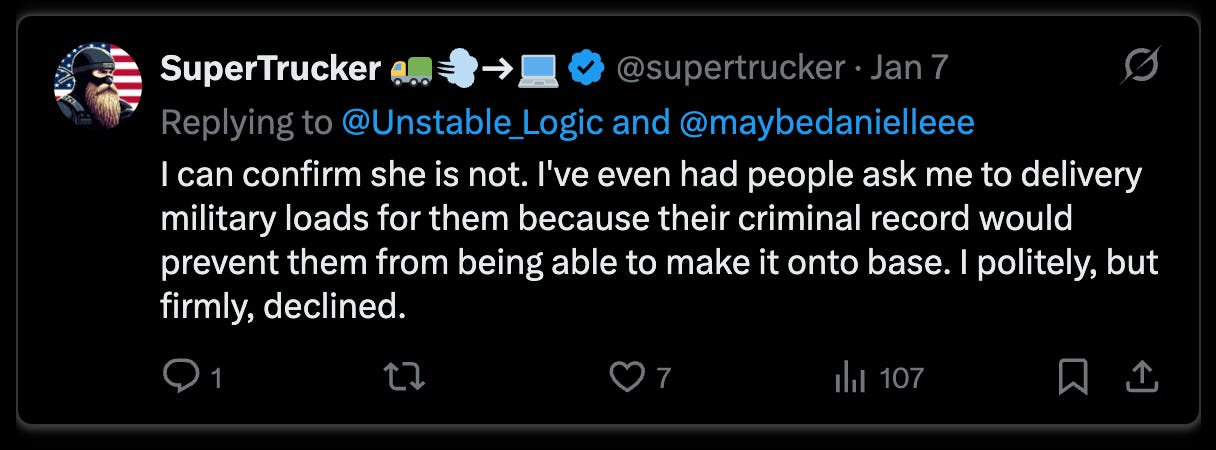
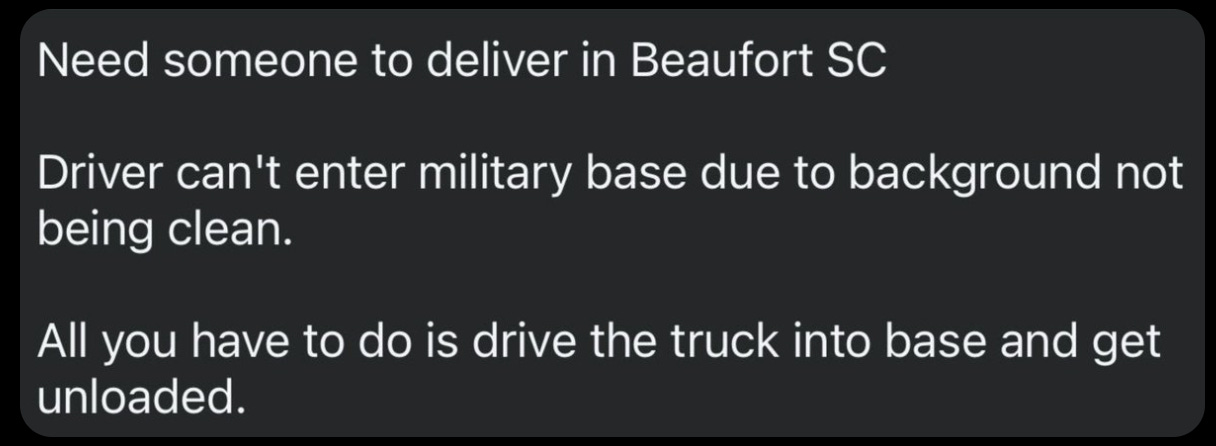
Once a carrier accepts a military shipment, the load can be quietly reassigned to a different driver. This ‘swap-seat’ maneuver is used when the original driver lacks the security clearances, identification, or base-access qualifications required to enter a military installation. In some cases, the replacement driver is recruited informally, at a truck stop or on Facebook, without the military’s knowledge or approval.
If a truck driver is deemed unqualified to make the final delivery, he shouldn’t be hauling military cargo!


Leadership has been warned.
Last year, a coalition of former Army officers and motor carriers, representing more than 300 combined years of DoD freight experience, submitted a 38-page briefing to USTRANSCOM and ARTRANS leadership.
The document included GFM screenshots, load manifests, broker chains, and documented fraud patterns. It called for immediate corrective action, system upgrades, and formal acknowledgment.
To date, there has been no response. Hundreds of documented cases remain unresolved, including concerns of mismatched equipment, forged insurance, and unauthorized drivers recruited at truck stops to access military bases.
Addressing the fraud would require acknowledging systemic failure. Maintaining the illusion seems to be easier.
A National Security Issue
Overseas, the DoD strictly controls logistics to prevent adversaries from gaining access to sensitive equipment. Domestically, it seems we are turning a blind eye to it.
Foreign-owned or foreign-linked companies can legally operate within these gaps. In some cases, military freight is being managed from outside the United States, with shipment data transmitted to overseas data warehouses. Sensitive equipment can be photographed, tracked, delayed, or diverted without detection.
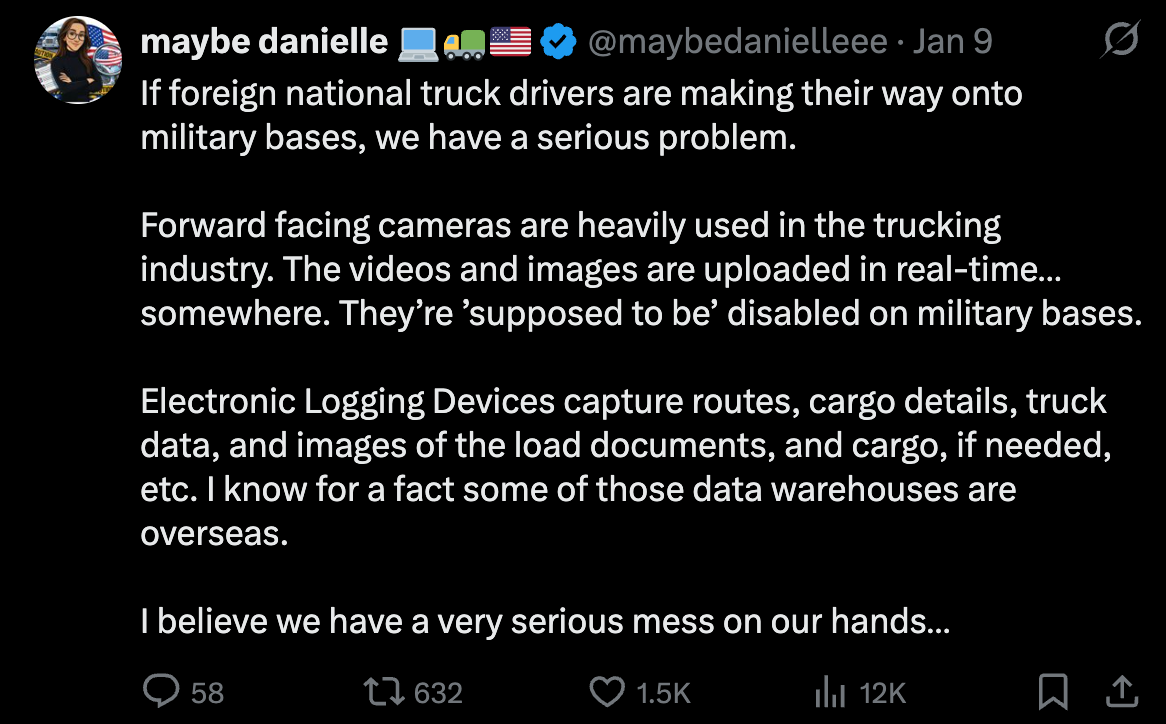
All it takes is one compromised shipment to trigger cascading consequences.
This Is Fixable
The fixes are neither experimental nor expensive. They already exist in the private sector.
Real-Time Vetting: Integrate existing federal safety, insurance, and authority data directly into military freight systems.
Capacity Enforcement: Match shipments to verified equipment and fleet size, automatically.
Transparent Brokering: Allow licensed brokers, but require full disclosure of subcontractors and equipment.
Accountability: Remove repeat offenders from eligibility. Enforce penalties consistently.
End-to-End Visibility: Track not just freight, but who touched it, when, and with what credentials.
Securing the Home Front
National security doesn’t stop at the border. It doesn’t stop at the port. And it certainly doesn’t stop at the loading dock. America’s highways are part of its defense infrastructure, whether we acknowledge it or not.
Linking military freight systems to real-time federal safety data, capping load awards based on verified equipment, restricting unauthorized brokering, enforcing automatic suspensions, and requiring full transparency would cost an estimated $12 million, less than 0.3 percent of a single year’s general-freight budget.
The cost of inaction is much harder to quantify and far higher.
The same blind spots that allow unsafe drivers onto public roads also allow unknown actors into military supply chains. Waiting for a catastrophic failure, a compromised weapons system, a terrorist incident, or a major diversion is not a strategy. It is negligence.
Senior officers and civilian leaders have been presented with documented evidence of these vulnerabilities. The systems remain unchanged. The technology to fix this exists. The data exists. What’s missing is urgency.
The Global Freight Management system can be fixed now, by choice.
Or later, by consequence.
Independent investigation requires independence. If you find this reporting valuable, consider supporting the research that makes it possible. Reader support funds data access, public records requests, and the analysis required to follow these issues wherever they lead.
This article/project wouldn’t be what it is without the help of @supertrucker. Thank you for your dedication, sir.